|
What
is Aquatic Therapy
Aquatic
therapy is a therapeutic procedure which attempts to improve function
through the application of aquatic therapeutic exercises. These
procedures require constant attendance of a therapist educated
in performing aquatic therapeutic exercises. Common synonyms:
Aquatic Rehabilitation, Aqua Therapy, Pool Therapy, Water Therapy,
Hydrotherapy (outside the USA). Note that aquatic therapy, as
defined by the American Medical Association (AMA), is not "tied"
to a single profession. It can arguably be performed by several
legally-regulated healthcare providers who have scopes of practice
which permit them to perform such services and who are permitted
to use the AMA's Current Procedural Codes (CPT)
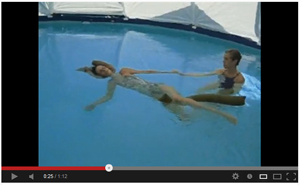 (
Click the photo to see the You Tube video )
(
Click the photo to see the You Tube video ) |
Aquatic
Integration with Cameron West
Aquatic Integration, developed by Cameron West, is a new
approach to hydrotherapy which combines eastern meridian
and point work with myofascial release, proprioceptive neuromuscular
facilitation and breathwork. AI is highly effective in restoring
sensory perception and motor control as well as increasing
range of motion and reducing muscular spasticity and has
proven a profoundly effective tool in pain management.
|
.
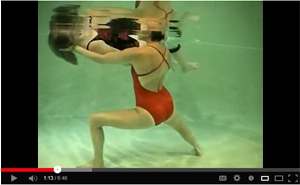 (
Click the photo to see the You Tube video )
(
Click the photo to see the You Tube video ) |
Aquatic
Integration Tutorial
By Cameron
West
|
Aquatic
therapy or pool therapy is physical therapy that is performed
in the water. Aquatic therapy use the resistance of water instead
of weights. It aims to rehabilitate patients after injury or those
with chronic illness, avoiding the amount of weight placed on
the joints by exercise outside the water.
The
Aquatic Therapy Association of Chartered Physiotherapists defines
aquatic physical therapy as: "A therapy programme utilising the
properties of water, designed by a suitably qualified physiotherapist
specifically for an individual to improve function, carried out
by appropriately trained personnel, ideally in a purpose built,
and suitably heated hydrotherapy pool" (ATACP, 2008). Also the
South African Aquatic Physiotherapy Group (2009) uses a definition
which is very much alike: “Aquatic physiotherapy is physiotherapy
which uses more than one of the unique properties of water for
therapeutic rehabilitation”.
A
Dutch definition, used in courses of the Dutch Centre of Allied
Health Care (NPI) is: "Aquatic (Physical) Therapy is a programme,
using mechanical and thermal characteristics of water during partial
or complete immersion, in combination with the effects of movement.
It evokes short-term and long-term adaptational mechanisms of
a person with a deranged biological system, using specific stimuli
to create biological and thus therapeutic effects."
Jenny
Geytenbeek, author of the Aquatic Physiotherapy Evidence-Based
Practice Guide (2008) , published by the National Aquatic Physiotherapy
Group of the Australian Physiotherapy Association, gives the following
definition and explanation: Aquatic Physiotherapy” refers to the
special practice of physiotherapy, with therapeutic intent toward
the rehabilitation or attainment of specific physical and functional
goals of individuals using the medium of water. It differs from
the more generic term “hydrotherapy” which connotes any water-based
therapy conducted by an array of professional specialties, including
immersion in warm water, immersion in mineralized water (balneotherapy
and spa therapy), immersion in mechanically turbulent warm water
(spa therapy), application of pressurized water to the external
body (whirlpool), application of warm water into the colon (colonic
irrigation), the application of water of various temperatures
and pressures via showers and towels (Kneipp therapy), and movement-based
therapy in water (hydrokinesiotherapy). “Aquatic therapy” similarly
refers to water-based activity of therapeutic intent, is common
among American literature, and includes the practice of e.g. physical
therapists, exercise therapists, nurses and exercise instructors.
“Aquatic exercise” has the intention of fitness training in both
healthy and symptomatic individuals, and “water exercise” is its
synonym."
Aquatic
physical therapy can be applied at all three dimensions of the
International Classification of Functioning, Disability and Health
(World Health Organisation, 2001). A fourth dimension is Quality
of Life, also an important goal in Aquatic Physical Therapy.
Aquatic
physical therapy might also be supportive in treating some of
the modern life-style conditions as well. A special issue of Physiotherapy
Theory and Practice titled ‘Physiotherapy practice in the 21st
century: a new evidence-informed paradigm and implications’, identified
topics like nutrition and weight control, sustainability of physical
activity and exercise, management of sleep disturbance and undue
life stress. Evidence is still scarce, but issues like obesitas
(Nagle 2007), adherence (Kang 2007), management of sleeping patterns
(Vitorino 2006) and stress reduction (Bood 2009) have been addressed
in aquatic literature, see also the chapter of the physiology
of immersion and the autonomic nervous system.
Therapists
who work in water typically seek aquatic therapy training as most
physical therapy programs do not provide education in aquatic
therapy techniques. Aquatic Therapy University and the European
Union Aquaevidence Network provide therapists with post-graduate
studies in aquatic therapy. In July 2010 the Board of the World
Confederation of Physical Therapy (WCPT) approved the start of
a formal network: Aquatic Physical Therapy International. This
network provides opportunity to (physical) therapists to connect
and share information. Objectives and activities are listed on
the website.
Examples
of aquatic therapy techniques include: Ai Chi, Aquatic PNF, the
Bad Ragaz Ring Method, Fluid Moves, the Halliwick Concept, Swim
Stroke Training and Modification, Task Type Training Approach
and Watsu. The originators of each of these unique technique worked
together with the Aquatic Resources Network to craft operational
definitions to aid in communication within the industry.
When
available, an interview was done with the creator of the technique
(Ai Chi, Fluid Moves, Watsu). When the creator was deceased, an
agent of the organization charged with managing the technique
was interviewed (Halliwick). When the technique was developed
over time by the contributions of many individuals, the interview
was done with an aquatic physical or occupational therapist who
has published work on the technique in either a professional journal
or textbook (Bad Ragaz Ring Method, Swim Stroke Modification and
Training, Task-Type Training Approach).
Back
to Index
SAIFTE
© All Rights Reserved. No part of this website may be reproduced
without written permission.
.
|